

Positioning is one of the hardest things to crack in any business. Get it right and you have a competitive edge and a clear reason why you win. Unless you have deep pockets to throw at your marketing, it can be the difference between thriving and surviving.
Here’s a simple test. Ask five people in your business why customers choose you over your biggest competitor. If you get five different answers, you don’t have clear positioning. You have opinions.
Even when your team agrees, a strong position has to be hard to copy. Words can be copied in minutes. If a competitor could put their logo on your homepage and it would still read true, you haven’t got a position that holds.
Sameness is a tax
When you sound like everyone else, it shows up in your P&L before anyone flags it as a positioning problem.
Customers treat you as interchangeable, so decisions come down to price. Customers take longer to decide, because nothing gives them a reason to choose you. And you see it in your marketing spend, which has to work harder every year for the same result.
It can show up as discounting. It usually starts as a short-term tactic to re-energise sales, then turns into a repetitive cycle. I’ve managed businesses that were hooked on discounting, with promotions running more or less continuously to hit the sales numbers. It masks the problem rather than fixing it, and leads to long-term erosion of profit.
Strong positioning removes that tax. When customers can see clearly why you’re the right choice, price stops being the deciding factor and the pressure to discount eases. Get it really right and the opposite happens: you earn the space to charge a premium, because customers are paying for something they can’t get anywhere else.
What competitive positioning actually is
Strip away the jargon and competitive positioning is the clearly articulated reason you win amongst a tightly defined audience, giving you a stand-out position when compared to your competitors.
Every part of that sentence matters. Clearly articulated means your people, your marketing and your leadership team all say the same thing. A tightly defined audience means you’ve chosen who you’re for, which also means choosing who you’re not for. Compared to your competitors means it only counts if it holds up next to the alternatives your customer is actually weighing up.
Once you know who you’re for, you can be clear about what you’re promising them. Are you living up to it in every way? Not just in the ad or the pitch, but in everything that follows? That promise is the nub of your positioning. You can’t make a promise worth keeping unless you understand what your customers value most about you.
What problem are you solving, and for who? The strongest, most defensible positioning runs deep. Surface-level answers like “we help businesses grow” are generic and meaningless. Go deeper. How do you help them grow? Why does that matter more than what competitors offer? Keep asking ‘why’ until you understand what’s true about you that your competitors can’t claim. Build your promise on that truth and you’ve found your positioning.
Why most positioning gets copied
The trouble with surface-level positioning is that it’s easy to copy. Think of the ways you can stand apart from a competitor as layers, running from the surface down to the core. The closer to the surface, the faster a competitor can copy you.
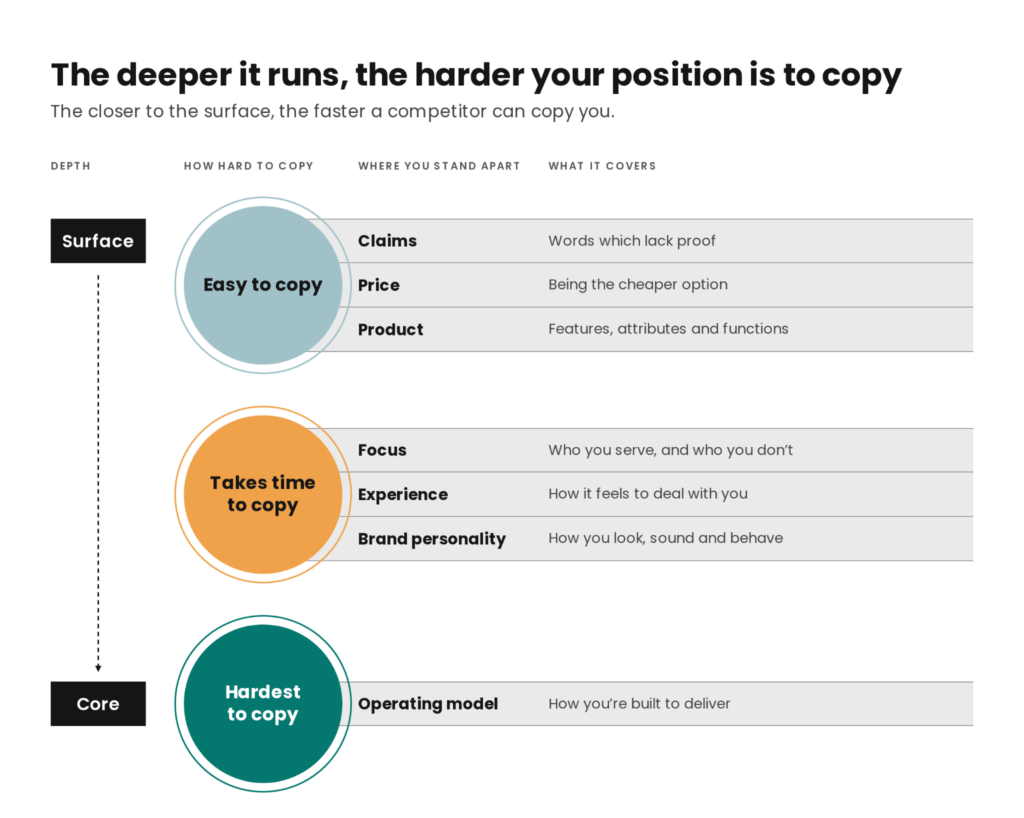
Claims sit on the surface: “Innovative.” “No.1.” “Customer-centric.” With no proof behind them, a competitor can copy you in the time it takes to update a web page. Worse, unproven claims don’t just fail to set you apart, they breed scepticism. Customers know when a claim isn’t backed up, and every one chips away at your credibility.
Beneath sits price. Unless it’s driven by an operating model advantage, a price cut can be matched overnight. It drags down margins for you and your competitors, and once a price war starts, customers learn to wait for the sale.
Then product. Unless what you’ve built is genuinely hard to replicate, a new feature lasts until a competitor’s next release, or they launch a new product to match yours.
Below the surface, things take longer to copy. Focus is who you’ve chosen to serve, and who you’ve specifically chosen not to. A competitor can change who they target in a planning cycle, but they then take on the complexity of moving away from customers they already have.
Experience is how customers feel dealing with you, from the first conversation or click to the moment something goes wrong. It takes time to design and to deliver consistently, which is exactly why a genuinely good one, the kind customers talk about unprompted, is so hard to copy.
Brand personality is how you look, sound and behave. Anyone can borrow a tone of voice, but a distinct personality held consistently over years becomes yours, and a competitor who copies it just looks like an imitation.
Deepest of all is your operating model: how your business is built to deliver. If the way you operate lets you sell for less, or look after customers in ways no one else can, a competitor can’t match it without rebuilding their own business.
Most businesses build their positioning from the three layers nearest the surface. Markets move and customer needs change, and when they do, surface-level changes let a business react fast. A new claim, a price cut or a product tweak can be in market within weeks. Deeper moves take more time and more effort, and the payback isn’t immediate.
Building a position that lasts means accepting the risk of a short-term knock to make the business stronger for the future. Repositioning is a risk, but it isn’t one without reward, provided it’s done with clarity and intention. A useful test: if a competitor could adopt your position without giving anything up, it isn’t a strong and sustainable position.
What keeps you different
The layers above are your source of difference, but two things are key to its longevity: insight ensures your position remains relevant, and culture embeds it in your delivery.
Insight keeps you relevant
Insight is how you understand what matters to your customers and the value you bring. It tells you whether a position is worth holding and it’s your early warning system, picking up the signals that things are changing.
Leadership teams can be too inward facing. They know their product inside out and see it the way they built it, not the way a customer experiences it. The view of who they compete with can be out of date. And their sense of why customers choose them tends to reflect what they’re proudest of, not what customers actually value.
Positioning only gets clear when you look from the outside in, and that takes human insight, not just data. Dashboards tell you what people did. Conversations tell you why. Talk to customers. Listen to the words they use when they explain why they bought. Use their language.
Look hard at where your competitors let people down. It’s one of the richest sources of insight because it shows you exactly what customers want and aren’t getting.
We worked with a health testing business that did exactly this. Benchmarking competitors’ customer journeys showed a category focused on the sale, with little support and advice for customers afterwards. Interviews with the nutritional therapists customers were regularly speaking to confirmed just how much the gap mattered. That shifted their positioning from being another testing provider to a partner in the customer’s wellbeing journey (read the case study). Change was built into the customer experience, making it harder to copy.
Positioning isn’t a one-time project. People’s needs, expectations and emotions move. Markets move. Technology opens up possibilities. A position that was sharp three years ago can be blunt today.
UK banking is the clearest example I know. Rewind a decade and the big high street banks knew their customers, with decades of data and millions of relationships. What they didn’t do was keep pace with what was happening outside their own sector, where people were getting used to apps that were fast, intuitive and genuinely useful.
New banks like Monzo and Revolut built the experience customers actually wanted: instant spending notifications, insight into where your money goes, accounts you could open from your phone in minutes. None of it was revolutionary technology. It was a better understanding of what would be genuinely helpful. The established banks were dragged into change by a more agile set of competitors who were redefining the category.
Culture embeds it
Insight keeps your position relevant. Culture embeds it, so your promise holds true.
I saw this first-hand at first direct. The operating model was the source of a new and distinct market position: a bank with no branches, built around the phone (followed by internet banking). But the brand was never just the model. It was built from a deep understanding of what customers wanted, with the internal culture needed to deliver it. That culture was threaded through every part of the business, from who got recruited to how success was measured. A competitor could set up a telephone bank. What they couldn’t copy was an organisation built from the ground up to put customers first, and the proof was there for everyone to see: first direct was ranked number one for customer satisfaction year after year.
That’s why culture is so hard to replicate. A competitor can’t copy years of decisions that all reinforce consistent direction and delivery.
On the flip side, a gap between what you promise and what you deliver erodes your position fast. If your website promises you’ll be there when it matters and your support queue doesn’t deliver, that feeds through into reviews and tarnishes your credibility.
What if you genuinely can’t be different?
In some industries, finding difference is hard. Products can be close to identical, regulation defines delivery and customers find it difficult to tell one brand apart from another. If that’s you, an alternative strategy can be to make yourself distinctive.
How you talk and look and the perspective you bring can make you stand out when the product itself can’t. Your brand personality is slower to copy than a claim or competing on price, and can be yours to own. If your brand personality has resonance with your customers, it builds trust and loyalty, but your words and actions can’t differ, they need to align. Read our previous article on differentiation or distinctiveness here.
More and more people are starting searches asking an AI tool for recommendations and you’d be right in thinking these tools can’t see your brand identity or recognise a distinctive tone of voice. They do, however, pick up on how often you’re talked about online. Ahrefs’ study of 75,000 brands found that brand mentions in various forms were the strongest predictor of a brand appearing in Google’s AI Overviews.
So distinctiveness still earns its place: a brand people remember is a brand people talk about. But to be recommended for a specific need, an AI tool has to be able to say what you’re different at: who you’re for, the problem you solve, the outcomes you deliver. Distinctiveness gets you talked about. Real difference gets you recommended. Without it, you get averaged into the middle of the answer. We call it the graveyard of the middle.
Where to start
If you’re not sure how deep your positioning runs, start with a few honest questions:
- Would your homepage still read true with a competitor’s logo on it?
- Do you know who you’re for and who you’re not for?
- Can you articulate why you win in one sentence, and do customers repeat it back?
- Are you delivering on your promise in every customer interaction?
- Are you discounting to win business you should be winning on value?
If your answers show inconsistency, it doesn’t mean you never had a strong position. Strong positions erode. You start chasing customers outside your core audience because the revenue is there. Your product roadmap bends towards the clients who shout loudest. You take action to counter a competitor’s move. Each decision is defensible, but together, they blur the position that made you different in the first place.
Many of the businesses we work with struggle to articulate their difference and present a clear definition of their target audience. Often messaging is built on internal opinion and is surface-level. Competitive positioning projects we run at Open Velocity start with customer and competitor insight. That’s how you build a position that runs deep enough to hold sustainable commercial value.
See how we approach competitive positioning
Not ready for that? Book a 30-minute Growth Clinic with a Senior Partner.
