

Summary: The “Graveyard of the Middle” is a precarious market position where businesses are neither the obvious, trusted category leader nor the unmistakable “only choice” for a specific niche, leading to increasing invisibility as marketing costs rise and returns flatten.
To escape, a company must achieve extreme clarity on exactly who they serve, what those buyers truly value and why they are the superior choice, effectively carving out a defensible niche before AI-driven decision-making patterns harden and exclude them entirely
Most businesses I talk to think their growth problem is a marketing performance problem. Rising ad costs, flatter returns, an agency that can’t explain why the numbers have slipped.
What they often actually have is a positioning problem that puts them in what I like to call “The Graveyard of the Middle”.
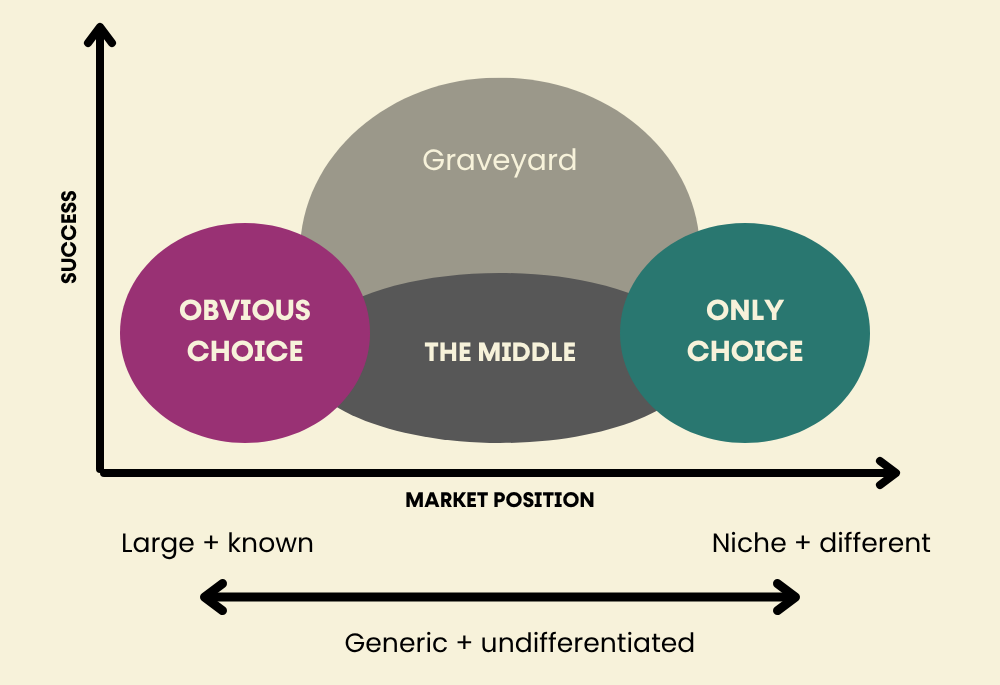
In summary: the graveyard of the middle is the space between being the obvious, trusted default in your category and being the unmistakable best choice for one specific kind of customer.
Businesses stuck in the middle are often competent, professional and increasingly invisible, both to customers and to the AI systems now shortlisting on their behalf. It applies whether you sell to other businesses or directly to consumers.
Here’s what’s actually happening.
The cost of doing marketing has been rising for years
Before AI entered the picture, three things were already making it harder for an ordinary, well-run business to compete on marketing alone.
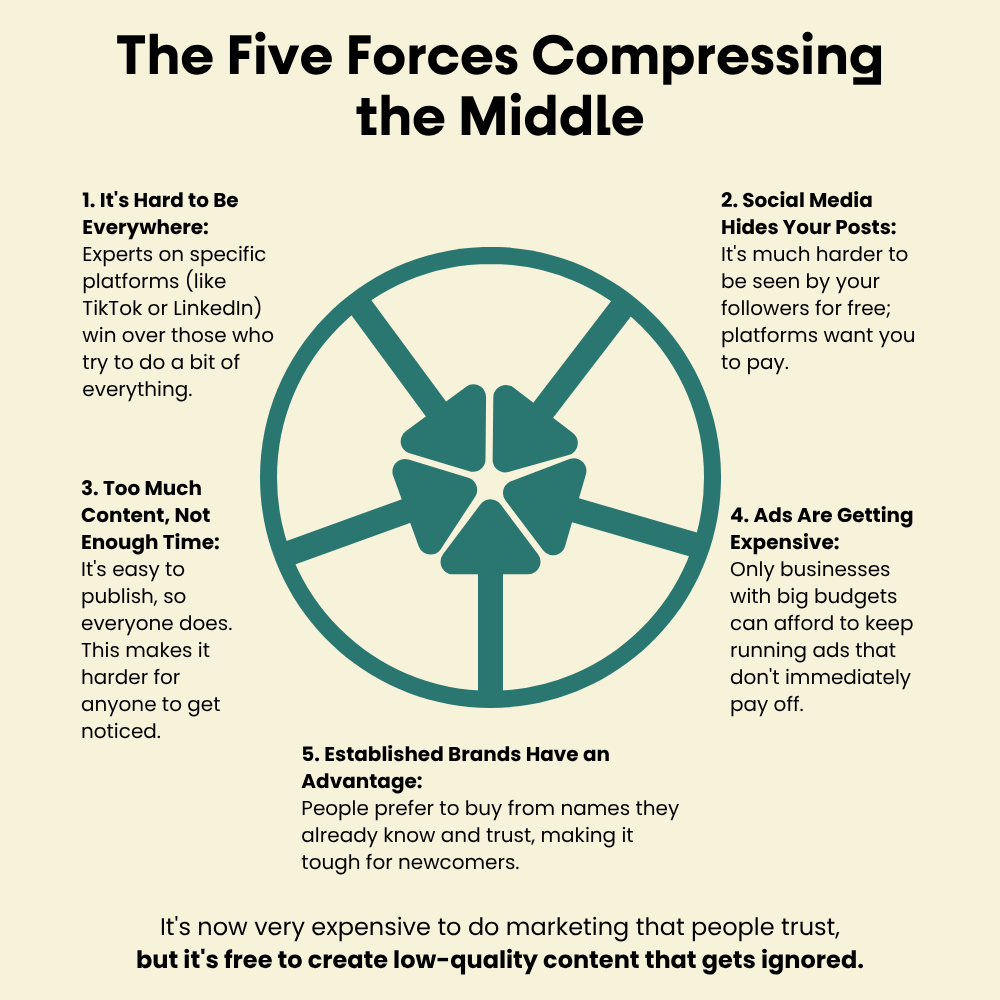
- The first is that there are simply more places you now have to show up and doing every channel well takes a set of diverse skills most teams simply can’t resource. A generation ago, competent marketing meant doing two or three things well. Now it means being fluent across several social platforms, search, email, events, PR and increasingly being visible in AI tools too, each with its own rules and its own skill set. Large businesses solve this by hiring a specialist for each one. Growth-stage businesses solve it by asking one generalist, or a small team, to be adequate at everything, which puts a ceiling on how good any single part of your marketing execution can be.
- The platforms themselves have made it more expensive to be seen. Every major platform has steadily reduced how many people see your content for free, because paid reach is how they make money. Facebook’s average organic reach has fallen from around 16% in 2012 to somewhere between 1% and 2% today, and the same pattern shows up across Instagram and LinkedIn. It means the free reach that used to reward showing up with a bit of effort has been steadily replaced by rising costs and the toll falls hardest on businesses without deep pockets to pay it.
- More people are chasing the same amount of attention. Anyone can start publishing content today with almost no cost or skill required and a huge number of people have. Human attention hasn’t grown to match it. The result is that even a genuinely good piece of content now gets a smaller slice of attention than it would have five years ago, purely because so many more people are competing for eyeballs on every platform.
- Paid advertising has become an auction that rewards whoever can afford to lose money for the longest. As more businesses compete for the same ad space, prices rise. Large, well-funded competitors can absorb a worse return per customer than you can, for longer than you can, simply because they have more capital behind them. That prices smaller and mid-sized businesses out of channels that used to work perfectly well for them.
- Trust builds like compound interest, and whoever started earning it earliest keeps the advantage. A business that has been visible, consistent and credible in its market for the longest keeps pulling further ahead in how trusted it looks, while everyone else has to work harder just to catch up to a credibility bar that keeps rising.
Put together, these five forces mean the real cost of doing marketing well, credibly and consistently, has been going up steadily for years, even before anyone had heard of a large language model.
Meanwhile the cost of looking like you’re “doing” marketing, starting a page, posting content, running some ads, has dropped to almost nothing.
This combination is exactly what floods the market with average, interchangeable activity while raising the bar for anyone who actually wants to stand out.
Then AI compressed the timeline
AI has accelerated this squeeze in three specific ways.
The way buyers make decisions has changed shape. Every previous shift in marketing, from print to search to social, moved influence to a new channel but kept the buyer on the same basic path: discover, compare, decide, then meet the brand. Increasingly now, a buyer asks an AI tool to build them a shortlist before they’ve visited a single website. If you’re not on that shortlist, you were never in the running. The decision has moved earlier than most marketing budgets are currently pointed.
Channels are also burning out faster than they used to. Every channel and tactic follows the same arc: it works, it gets adopted by everyone, it stops working as well. AI has made it worse, because it makes low-relevance, high-volume activity almost effortless to produce, which fills every channel with noise faster than before.
Everyone now has access to the same tools, which means those tools stopped being a differentiator the moment everyone adopted them.
AI has made producing marketing content, copy, images, research, dramatically faster and cheaper for every business at once, including your competitors. Being fast, polished and prolific used to give businesses an edge. Now everyone is flooding platforms with lookalike marketing that doesn’t get anyone noticed in the noise.
Why this creates a graveyard in the middle
There are really only two positions worth holding in a market like this.
The first is category leader: the largest, most recognised, safest default that nobody needs to think hard about. Holding that position takes genuine firepower, deep budget, years of accumulated scale and brand recognition. If you’re not there already, trying to out-spend your way into it is rarely realistic for a growth-stage business, whether you sell to other businesses or straight to consumers.
The second is the specific niche: unmistakably built for one kind of customer with one kind of problem, and clearly the best answer within it. This is the position genuinely available to most growth-stage businesses. It doesn’t require a huge budget. It requires real clarity about who you are and are not for, which is a harder problem to solve than it sounds, and that difficulty is exactly what keeps businesses stuck in “the graveyard middle” rather than committing to a well-carved out path.
Almost every business in the middle sits there not because it chooses to, but because it didn’t explicitly choose not too. It’s where growth dies.
It’s dying because customers used to have limited information and limited patience for gathering more of it, so being competent and available was often enough to win. AI has removed both of those limits. A customer, or an AI system acting for them, can now compare an entire market in the time it used to take to read one homepage or product page.
Once comparison is that easy, there’s no reason left to settle for generalist and average. You’re either the leader, backed by the resource to justify it, or specific enough to be the only sensible answer for someone. Everything else gets filtered out before a human is even involved.
What the graveyard of the middle actually looks like
Businesses in the graveyard of the middle are usually profitable, well run and staffed by capable people. Revenue has grown, often on the strength of the product, an early channel that worked, or a founder’s personal network. None of that is wrong. It’s just no longer sufficient on its own.
What defines the middle is this. If a prospective customer, or a machine acting on their behalf, tried to explain in one sentence why this business specifically is the right choice, they couldn’t do it without reaching for the same handful of words every competitor also uses.
Trusted. Experienced. Innovative. Best. Leading.
Those words describe attributes a whole category aspires to, not one company within it. A description that fits everyone is worth nothing as a reason to pick you.
The businesses that get squeezed out of the middle aren’t doing badly. They’re never had to answer a hard question about why they win, because for a long time they simply didn’t need to.
Signs you might be in it right now
A handful of patterns show up consistently in businesses sitting in this space.
- Growth used to come reliably from one or two channels, and those channels have stopped delivering the same return, with nothing obvious to replace them.
- Customers and prospects tell you they’re comparing you against two or three competitors who all sound roughly the same on paper, and you win on price, relationship or timing rather than on a clear reason to choose you over them.
- Your team, or your agency, struggles to answer “why us” without reciting a list of capabilities. A capability list is table stakes. It’s not a reason.
- You’ve increased how much content and activity you’re putting out, and the return on all of it is flattening even as the volume climbs.
- Nobody internally could tell you, in one sentence, exactly who you deliberately choose not to serve. If the honest answer is “anyone who’ll pay us,” that’s a strong signal you’re in the middle.
If two or more of these sound familiar, the problem isn’t your execution. It’s your positioning.
What to do about it, and why speed matters
The instinct when growth flattens is to do more. More content, more campaigns, more channels, more AI-assisted output. Given everything above, that instinct is exactly wrong. Doing more while your positioning is unclear just puts the same unclear message in front of more people, faster.
The route out of the middle isn’t more activity. It’s extreme clarity about three things, in this order.
WHO, precisely, you are for. Not a broad market or a job title, but the specific kind of buyer, with a specific kind of problem, where you can make a genuinely strong case that you’re the right choice.
WHAT that buyer actually values, in their own words. Not what you assume they care about, but what they’ve told you, in sales conversations, reviews, support tickets and lost-deal conversations, It’s what actually drove their decision. Most businesses build their pitch around what they’re proud of rather than what their buyer has told them matters. Those are rarely the same list.
WHY what you offer is better than your competitors, shaped directly by the answers to the first two. Once you know precisely who you’re for and what they value, your offer and your positioning should follow from that, not sit apart from it as a separate messaging exercise. This is the difference between a business that says it does everything well and a business that can say, credibly, why they are the only sensible choice for a buyer exactly like you.
This is the actual route to winning in a market that’s polarising. Not more channels, not faster content, not another tool. Clarity, applied consistently everywhere a customer or a machine might encounter you, is what moves a business out of the graveyard and into either the category leader position, if you genuinely have the resource to hold it, or a defensible niche, which is available to almost any business willing to do the work.
Speed matters because the middle isn’t shrinking gradually. Every one of the forces described here, long-term and AI-driven ones, are compounding. The businesses that get clarity now, get to define how they’re understood before that definition hardens into whatever’s already been said about them online. The ones who wait don’t get a version of the same problem later. They get a harder one, because by then the shortlist will already have been built without them.
Frequently asked questions
What is the graveyard of the middle?
It’s the market position between the category leader, the large, trusted default backed by scale and budget and the specific niche business that’s unmistakably the right choice for one kind of customer. Businesses that hold neither position are generalist, professional and increasingly invisible, both to customers and to the AI systems customers now use to build a shortlist.
How do I know if my business is in it?
The clearest sign is that you can’t explain, in one sentence and without resorting to generic language like trusted or experienced, why a customer should choose you over two or three named competitors. If your team or agency answers “why us” with a list of capabilities rather than a specific case, that’s the same signal.
Is this a B2B problem or a B2C problem?
Both. The same forces apply whether you sell to other businesses or directly to consumers. AI tools increasingly shortlist products and services for individual consumers the same way they shortlist suppliers for business buyers and the middle of any consumer category is compressing in exactly the same way.
